suggsy

My best pal Suggs.
Friday, 3 February 2012


Monday, 30 January 2012
Down the park
A quiet but cold day down at the park, the usual suspects were presant Grebe, Pochard,Canada geese,Mallard, moorhen,coot and about 30 black headed gull's.
The pair of great crested Grebe's where very active, running (as they do) up n down the lake and head shaking in that cute, courtship dance.
I am now starting to take more notice off some of the smaller birds in the park and actualy saw a treecreeper scurreing up an oak tree, a lovely little bird But you guessed it I didn't get a shot.
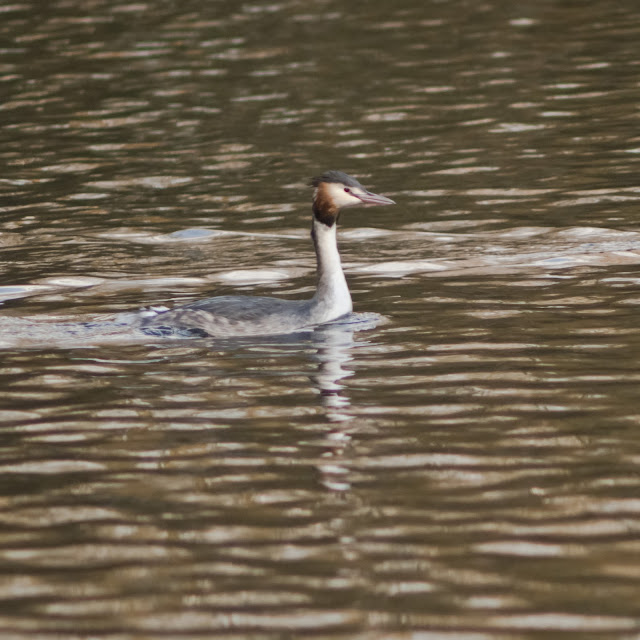

 On the next visit to the park I will have to remember to share my time between the lake & the woods also to remember to change lens to a smaler faster auto focus one. Regards Bri
The pair of great crested Grebe's where very active, running (as they do) up n down the lake and head shaking in that cute, courtship dance.
I am now starting to take more notice off some of the smaller birds in the park and actualy saw a treecreeper scurreing up an oak tree, a lovely little bird But you guessed it I didn't get a shot.
 |
| My first decent shot of a bird in flight (more luck than judgement ) |


Sunday, 29 January 2012
RSPB Burton Mere
General views off Burton Mere taken on the 26/01/2012

 10,000 reeds have been planted to establish the reed beds
 |
| Above & below - Canada geese, Teal, Snipe, & Mallard. |

 |
| Gray Heron sheltering from the cold wind. He didn't move much in the 2 hours I spent watching from the shelter of the hide. |
 |
| Reed beds looking toward Wales |
 |
| The hide in this shot is where I spent 2 hours watching the pair of Heron. |

Friday, 27 January 2012
As Wallace would say to gromit A GRAND DAY OUT LAD.
My trip to Burton mere really was a grand day out, bright n cold then dark n wet then bright n wet then really bloody cold and time to go home but enjoyable non the less, on arriving I introduced myself as a new member visiting a reserve for the first time, I half expected a list of does & don't s but actually got a half hour guided tour which proved to be really helpful. The staff are proud of what they have achieved over the last few years and so they should be.
Now for the birds, there are lots n lots of geese - mostly Canadian, pink footed a few white fronted and greylag s in the mix, all to far away for me to photograph with any kind of success but just seeing these large birds in flight over the Dee estuary is a magical sight.
While photographing a blue tit preforming acrobatics on a bull rush, a commotion amongst the reeds started and the biggest swan I have ever seen flew over my head! and no I didn't get a shot of that either (50/50 mute - whooper according to the experts which means it was too quick for them and not just me )
A nice quiet hour was spent in a hide out on the marsh overlooking a scrape with a pair of Gray heron looking quite comical - see photo below, a large number of snipe and yet more Canadian geese were also present. I have no doubt that there were a lot more wild fowl present then I could see this is a large area and I don't have any bins yet. I hope you enjoy the photographs & if you could help me by identifying the bird on the feeder it would be a big help
Regards Bri. and a big thank you to all the staff at R.S.P.B. Burton mere.


 |
| Help I don't know what this is ( Goldfinch ? ) |

 |
| Everyone in the hide laughed when someone said MEXICAN STANDOFF |
.jpg) |
| Blue tit amongst the bull rushes |


 |
| Male Tufted duck shot against the sun |
Tuesday, 24 January 2012
New R.S.P.B. member an old git!
Because of all the medication I take getting out has been a bit of a problem , tablets make me drowsy - so I cant drive, it takes 2-3 hours for the fog to clear from my head every morning , all I can say is thank god for local parks such as Acton in Wrexham.
A local fishing club maintains the area around the lake & provides platforms (for fishing from) large & safe enough for wheelchair users to view from or indeed fish from, I find them handy for my tripod!. The park is a 10 Min walk away but traffic concerns mean that I can only get there if my wife or son walks with me, once there i,m as happy as a pig in - well you know
Anyway to the RSPB. I joined early this month & I am paying my first visit to a reserve on the 26th to Burton mere on the Dee estuary, I am really looking forward to seeing something other than pochard, grebe, mallard & Canada geese, not that I,m bored with my usual suspects, I just want to see something different - a little egret would be nice. As I have said before I don't want or expect sympathy from anyone. My anxiety, depression is my problem which I have to deal with but I have to admit that I feel at my best when out watching our little or large feathered friends.

 P.S Big thanks to the wife - she,s driving on Thursday. Regards sad old git.
A local fishing club maintains the area around the lake & provides platforms (for fishing from) large & safe enough for wheelchair users to view from or indeed fish from, I find them handy for my tripod!. The park is a 10 Min walk away but traffic concerns mean that I can only get there if my wife or son walks with me, once there i,m as happy as a pig in - well you know
Anyway to the RSPB. I joined early this month & I am paying my first visit to a reserve on the 26th to Burton mere on the Dee estuary, I am really looking forward to seeing something other than pochard, grebe, mallard & Canada geese, not that I,m bored with my usual suspects, I just want to see something different - a little egret would be nice. As I have said before I don't want or expect sympathy from anyone. My anxiety, depression is my problem which I have to deal with but I have to admit that I feel at my best when out watching our little or large feathered friends.


Saturday, 21 January 2012
Photo,s taken with tair 300mm
 |
| As this lens was designed in the 1930,s it suits B&W |
 |
| Taken from around 20mtrs away |
 |
| About 5mtrs away |
 |
| Not bad for a lens around 30 to 40 years old |
 |
| Add a 2x converter & this is around 45mtrs away |
 |
| I still can,t get-over how sharp this lens is |
TAIR 300mm Russian lens
 |
| Aperture set to f22. |
 |
| l/h side Three things to notice 1, Large wheel at front of lens is for focusing 2, Silver leaver under rear of lens is used to release aperture mechanism 3, Large red dot above leaver is for cocking aperture (as in cocking a gun) |
 |
 It sounds complicated but you soon get used to it, the sequence is as followsThe way the FS-12's trigger mechanism works is as follows:1,first you cock the aperture mechanism and focus on the subject. 2, Then after metering you set the desired aperture 3, when everything is set tap the leaver and press the shutter release, simples If you are interested in Russian lenses then visit .alfredklomp.com for more info
The way the FS-12's trigger mechanism works is as follows:
The way the FS-12's trigger mechanism works is as follows:
The way the FS-12's trigger mechanism works is as follows:
|
Subscribe to:
Posts (Atom)